Costa Rican Birding Adventure
by Ned C. HillPart 2—The
Monteverde Cloud Forest |
 |
|
The Cloud Forest
by Ned Hill |
 |
Jacó to Monteverde
Day three of our adventure again began at 5:30 am when we looked for birds
from the motel balcony and enjoyed breakfast. Three Bare-throated
Tiger-Herons strutted on the roof of the neighboring building puffing out
their yellow throat patches and making guttural sounds. It was a rather
comical sight. We identified a White-fronted Parrot in a distant tree and
saw three noisy Mealy Parrots fly over. Dennis spotted for us a
Thick-billed Euphonia perched in the top of a tree. Determined to get a
good look at the Rufous-tailed Hummingbird, I sat by the pool until one
perched on a branch for me to study it. As this was Sunday, we held a
brief Church service in Dennis’s room and then loaded up the van.
On the way out of town on this bright, sunny morning, Tuula spotted a
Roadside Hawk perched on a pole—where else—on the roadside. We did a quick
U-turn and went back to study it. At the Tarcoles River Bridge, we found a
very aggressive Cinnamon Hummingbird defending its flower patch. It is a
close relative of the Rufous-tailed so we had to study it carefully. This
is the northern-most extent of its range. No Barred Antshrike that Tom and
Carol Jean had seen at this spot before we arrived.
We stopped for gas outside Puntarenas where I met a German man who moved
here 20 years ago. He told me in German that there were many of his
countrymen in that area. He is a rock mason. He also told me that many
Mormons had settled Monteverde where we are headed. "They make great
cheese up there." We think he was talking about the Quakers.
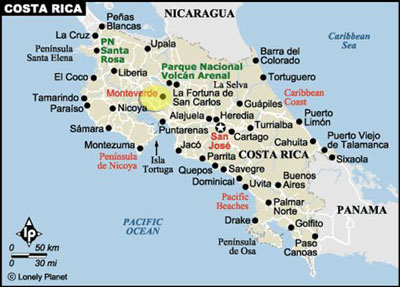
We finally left the Pan American Highway and started up the famous—or
infamous—40 km long dirt and rock road towards Monteverde. It’s pretty
rough and demands very tough tires. We were amazed that this most famous
of all Costa Rican natural attractions does not merit a paved road.
Perhaps the road is a barrier to overuse. We later saw T-shirts boasting,
"I survived the road to Monteverde." We stopped several times to check the
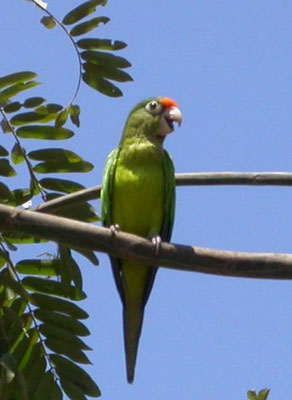
birds, once finding an Orange-fronted Parakeet when we stopped to see the
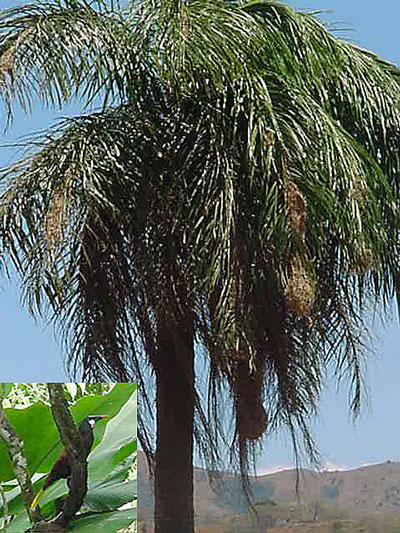
Groove-billed Anis. We also saw a Montezuma Oropendula fly over and then
saw this species’ huge nests hanging from a palm tree. They are like large
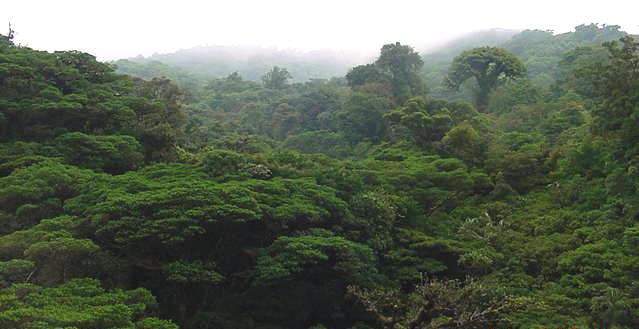
tubes. The terrain is very dry and mountainous here but in the distance we
could see dense clouds blanketing the top of the cloud forest. After
seemingly endless bumps and lurches we finally reached the spread out
towns of Monteverde-Santa Elena. A soccer game was being played in a park
next to a school and the whole town was there to watch. Fans sat on the
steps of businesses to cheer on their team. We finally reached a paved
road—but like a mirage, it disappeared as soon as we found it and we went
back to bumping and lurching. At last our motel appeared: the Miramontes
Swiss Hotel with its lovely grounds of grass, flowers and orchids. The air
was cool, a welcome change from the steamy humidity of the coastal area.
Walter Faisthuber, the proprietor, greeted us and led us to our spartan
rooms. Some rooms did not have hot water but others did. There were no TVs
nor phones to distract us. We immediately found a Yellow-faced Grassquit
and Rufous-collared Sparrow in the lawn and saw some hummingbirds we
couldn’t initially identify at the flowers. We could hear the ringing call
of the Three-wattled Bellbird but we could not locate it.
|
 |
|
Orange-fronted Parakeet by
Milton Moody
|
 |
|
Montezuma Oropendula and Nests
Photos by Ned Hill
|
| |
Hummingbird Gallery
After a brief break to unpack and enjoy a quick lunch on Dennis’s porch,
we loaded into the van for the bumpy drive up to the entrance of the
Monteverde Cloud Forest Preserve. We did not go in this afternoon because
our target was a gift shop called for good reason the "Hummingbird
Gallery." Within a few seconds, we saw 8 lifers! They have a dozen or so
hummingbird feeders around the outside of the shop and these are visited
by zooming, bickering hummingbirds—at least seven different species plus
Bananaquit, a small warbler-like bird with a yellow belly. There were
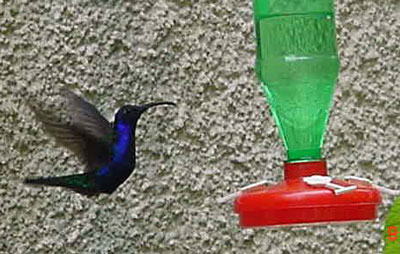
large Violet Saberwings—beautiful purple hummingbirds with downcurved
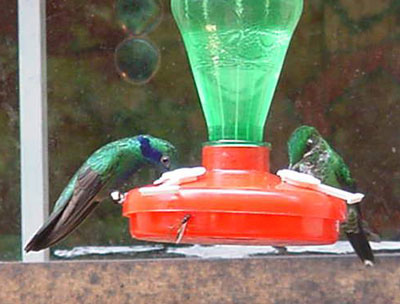
bills and white undertails. We also saw Purple-throated Mountain Gem,
Green Violetear, Green-crowned Brilliant, Coppery-headed Hummingbird,
Stripe-tailed Hummingbird, and the tiny Magenta-throated Woodstar that
hovers with its tail up when it feeds. We could approach them to within a
couple of feet and get great photos. They zoomed by so closely we could
sometimes feel their wings brush our heads. Some of our group went into
the gift shop to buy T-shirts and postcards. LeIla is our chief shopper.
Besides hummingbirds, we found a Common Bush-Tanager, a dull,
khaki-colored bird that became THE bird for Carol Jean for some unknown
reason. From then on, we were careful to point out that bird whenever we
saw it. In a branch above the road we found a singing White-throated
Robin. We drove down a mile or so and stopped at a turn out where Carol
Jean spotted high in the trees a couple of Golden-browed Chlorophonias one
of the most striking of the tanagers: green back, yellow breast and brow,
black band and blue nape. One of our favorite birds of the trip. How did
Carol Jean see them way up there? Further down the road, next to a farm
field owned by some Quakers, we found a pair of Keel-billed Toucans and an
Emerald Toucanet—another very colorful green bird.
Back at the Swiss Hotel, we ate dinner in the small dining room where
Walter entertained us with some classical guitar pieces. Then he and Kathi
sang together (one number was the Simon and Garfunkle "The Boxer") while
he accompanied on the guitar. Not bad at all! The only problem was that
some of the guests at dinner decided to smoke—typical European custom. I
found an interesting centipede in my shower and Dennis was disappointed I
didn’t collect it for him!
|
 |
|
Violet Saberwing by Ned Hill
|
 |
|
Green Violetear & Green-crowned Brilliant by Ned Hill
|
| |
Monteverde Cloud Forest
Preserve
The wind blew strongly all night and it became quite cool. Some of us
were up very early to look for the Bellbird just off the property. We
could hear its metallic, echoing "PRONNNG" clearly and approached the
sound but it always was further off than we calibrated. We did see
Keel-billed Toucan. Breakfast was excellent: fruit, beans and rice, and
scrambled eggs plus hot chocolate and bread. Then off to Monteverde Cloud
Forest Preserve. They admit only a limited number of people into the
preserve at any one time so we had to be sure to get there early or we
would have missed out for the morning. It was cool enough for a jacket and
one never knows when it might rain in a cloud forest. When we arrived
there were bus loads of students but we were able to get in.
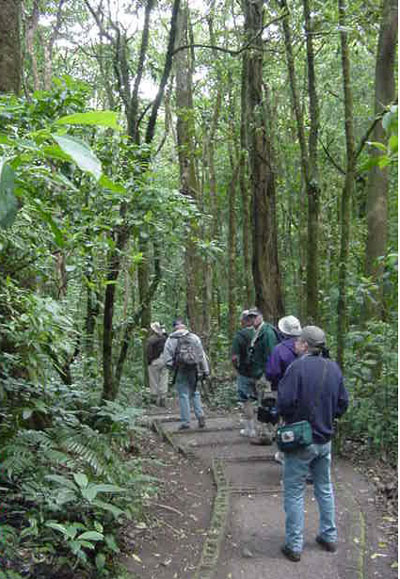
We chose a trail not popular with the crowds. It was dark, moist and
absolutely beautiful. Large trees were completely covered with epiphytes
of all varieties. The trail consisted of cinderblocks laid so we walked on
the open spaces filled with dirt. The footing would have been treacherous
in the rain without the precautions they took. Very quiet. We soon heard
the ringing, thrush-like sound of the Black-faced Solitaire and finally
saw one relatively close to us. A loquacious singer, the Gray-breasted
Wood-wren, was coaxed into view. Then Tom found a small bird but it
flitted away. Bryan decided to give in and use the Costa Rican bird CD. He
played the sound of the White-throated Spadebill and immediately, Tom’s
little bird flew near enough for all to see it. We tried that technique
with Slate-throated Redstart and immediately had several surrounding us.
We had been hearing their calls and knew they were nearby but just
couldn’t see them. That’s the problem with forest species. We heard an
Orange-bellied Trogon in the distance and tried calling it in. It worked
again and we got great looks at that beautiful species. We hope we are not
upsetting their nesting behavior. We only used the CD sparingly and never
for very long.
A Green Hermit (a hummingbird with a long tail and downcurved beak)
hovered near us and several Three Striped Warblers sang for us. Nearing
the end of the looped trail, we found a great little woodcreeper, a
Spotted Barbtail, and saw another Slate-throated Redstart on the trail
where we could see its little rufous cap.
Back at the gate area, we took a break to have a snack and rest for a bit.
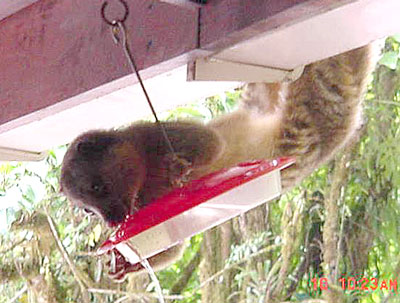
They have a couple of hummingbird feeders around a picnic area. Nothing
new except a Kinkajou that came down from the roof and wrangled its way to
a nice drink of hummingbird nectar. We talked to some people from Oregon
who told us where to look for Quetzals. Most people on the trails speak
English—even many of the school kids are Americans.
We set out again into the cloud forest, this time on the Camino Trail. We
found a Yellowish Flycatcher, a Ruddy Treerunner and a Red-faced Spinetail.
We walked up and down steep trails trying to locate the Quetzal area and
finally located it. It was marked by a tall stump with evidence of a fresh
hole being dug by the female Quetzal. We searched high and low until Bryan
spotted the female Resplendent Quetzal very high in a huge tree. It was
not green like pictured in the field guides but turquoise blue with a red
belly—at least in that light. I thought it was a macaw at first. Dennis
soon located the male—also blue! Their feathers are iridescent and depend
on reflected light for their color. The male’s huge tail was amazing. A
Spanish-speaking couple came by and we pointed the Quetzals out to them.
They seemed thrilled to be able to get a good look through the scope.
We returned to the picnic area where they had a small concession stand. We
bought lunch: chicken, rice and vegetables. Most of us avoided the lettuce
and tomatoes but we heard that up here they are not dangerous. Then we
left for lower right-hand trail where, in the late afternoon sun, the
forest was fairly quiet. We saw another Orange-bellied Trogon and got
great looks at Emerald Toucanet that some of us missed yesterday. We heard
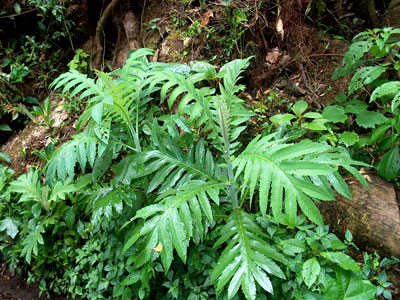
some very strange sounds coming from a thick patch of ferns and discovered
they were made by Gray-breasted Wood Wrens.
On the way back to our hotel, Dennis and Bryan took us to their favorite
restaurant, Johnny’s Pizza. It was excellent. Our legs ached from the four
to five miles of hiking we had done up and down steep trails. We all slept
well while the wind picked up and the temperature dropped. I called home
and found that the BYU basketball team had won its last two games and thus
shared the conference championship with Utah.
We were up in the brisk wind at 5:15 to search for the Bellbird. We
immediately heard it’s penetrating "PRANG" in the distance and headed out
in that direction. We plunged through heavy grasses and trudged over hilly
pastures hoping that chiggers would not invade our socks and shoes. Three
Chestnut-headed Oropendula flew over us. The Bellbird was very close but
high in a group of trees. It would give several equally spaced, clear
whistles and then "Prang!" We surrounded the suspect tree but it was
protected by smaller trees and undergrowth. Dennis glimpsed it fly from
one perch to another and then it flew out and bounded away towards another
tree. We only caught sight of a mid-sized brown bird with a light head. So
close but not a very good look. We could hear it "Pranging" again in the
distance. We did find a White-crowned Parrot and a Gray-crowned
Yellowthroat.
|
 |
|
Trail in Monteverde Cloud Forest
by Ned Hill
|
 |
|
Kinkajou at a Hummingbird Feeder by Ned
Hill
|
 |
|
Ferns in Forest by Tom Williams
|
| |
Ecological Farm
After another hearty breakfast at the hotel we headed to a slightly lower
altitude below the Monteverde Cloud Forest. The place is called the
Ecological Farm—it’s an old farm that is now a great birding spot with
open secondary woods and remnants of a banana plantation. It has a
completely different set of birds than can be found in the cloud forest.
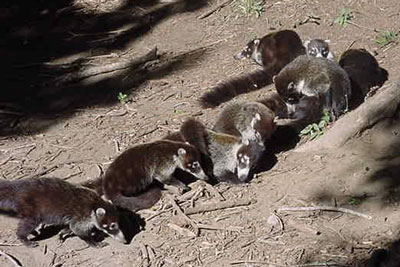
We found a family of White-nosed Coati gathered on the edge of the parking
lot. They look like they are related to our racoons. The first new bird we
spotted was turning leaves in the undergrowth—a cute little White-eared
Ground Sparrow. A familiar Ovenbird walked in front of us on the trail.
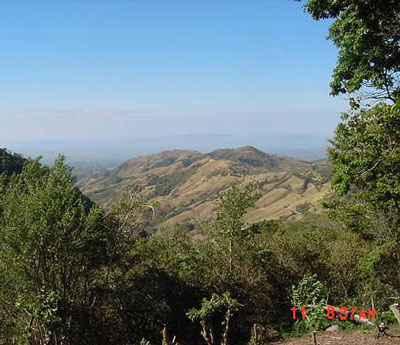
Then we went to an overlook affording us a view all the way down to the
Pacific Ocean. Bryan used a tape to call in a Rufous-browed Pepper Shrike
and a Plain Wren. A short distance from the overlook was a known lek of a
Long-tailed Manakin, one of the most desired targets of the trip. We could
hear the call notes and the wing popping similar to the Orange-collared
Manakins we found in Carara. We all fanned out along the trail to watch
for the bird. Soon Dennis had the bird in view. All rushed up to get a
look. It disappeared before I could see it well. Then a male flew in again
to a tree branch just above our heads in full sun and all of us got a
great look at the long tail streamers, blue back and red head. What a
beautiful bird!
At the edge of an old banana grove some of us found a Chiriqui Quail-Dove
walking along hunting for insects. It disappeared into the thick
undergrowth before all of us got the chance. As we sat on our folding
stools in front of a large bush of flowers, a number of hummingbirds came
in. One fairly large one had a down-curved bill: a Green Hermit. Another
was a female Fork-tailed Emerald. When some of the group plunged into the
underbrush to look for the Quail-Dove, they found instead several
Gray-headed Chachalacas. All of us followed them to see these new birds.
In the distance, another Bellbird teased us without showing itself.
However, a female Three-wattled Bellbird flew into a tree in an old
orchard. It looks like a different species from the male—green with a
lighter, streaked breast. A Golden Olive Woodpecker also flew into one of
the orchard trees. We identified a Steely-vented Hummingbird with light
gray "leggings" around its feet.
|
 |
|
White-nosed Coati Family by Ned
Hill
|
 |
|
Overlook to the Pacific Ocean by Ned Hill
|
| |
Selvatura Skywalk
One of the problems in birding in thickly forested area is finding and
identifying birds that prefer the canopy. To give birders better odds and
to provide a unique view of the forest, people have started building
"skywalks" through and above the trees. The newest of these in Monteverde
is Selvatura. We arrive there after a tasty lunch in town. The first thing
to do at Selvatura is to visit their new hummingbird gallery. Green
Hermits came in several times but the other hummers were the same species
we had seen in Monteverde. As we watched hummingbirds an American
Swallow-tailed Kite flew over our heads displaying its graceful forked
tail.
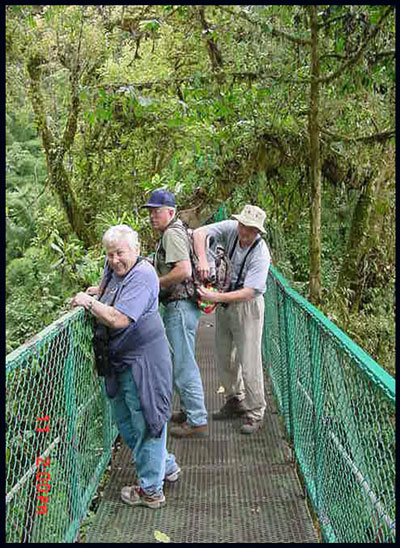
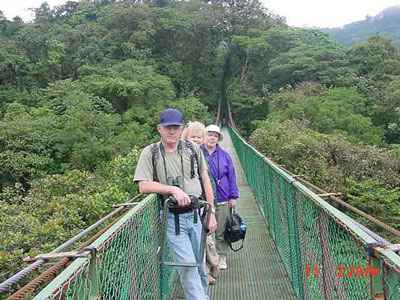
The day was cloudy and cool—rain threatened. The trail goes over eight
bridges that take visitors above or into the canopy. The huge trees are
covered with epiphytes. From the first bridge, we found Ochraceous Wren
working a trunk and a Red-faced Spinetail in the branches. I had missed
that one the other day. From the trail we came upon a "kettle" of birds
and people began calling out "Collared Redstart, Three-striped Warbler,
Golden-winged Warbler, Barred Becard…" They flitted here and there so
quickly, I missed most of them.
High in the trees near one of the longer bridges, we heard the strange
sounds of the Prong-billed Barbet—almost like the Laughing Kookaburra in
Australia. With some effort, we found several of them in the canopy and
could not call them down any closer. As we searched for the barbets, Carol
Jean spotted a Brown-headed Parrot also very high up. The view from this
long bridge was spectacular with the forest canopy stretching out below
our feet and clouds swirling over the horizon. At the far end of the
bridge in the shrubbery, we found a black bird with strikingly yellow
"leggings," the Yellow-thighed Finch. The strong breeze and late afternoon
combined to keep many birds out of the canopy.
Back at the parking lot—now almost socked in with mist—we found
Blue-and-white Swallows perched on a wire and before we got into the van,
a Black Guan sailed right over our heads.
When we returned to the Swiss Hotel, Walter told us that a male Bellbird
had sat for over an hour in a tree right across the street! Such is
birding. We ate at the hotel and then some of us went owling. It was
fruitless because of the wind and the feeble power of our CD player and
tape recorder. We soon gave up and went to bed.
Before we left this heavenly area the next morning, we birded a little
down the road from the hotel—again hearing but failing to find the male
Bellbird. Again we got a look at the female. And we added Eastern
Meadowlark and Western Wood Peewee to our list. Before we boarded our van,
Walter showed us some of his 4,500 specimen butterfly collection. It’s
amazing to see the variety of colors, sizes (from ½" to large 7-8"bird
butterflies from SE Asia) and shapes of butterflies in his collections.
Many Morpho butterflies are bright blue on the upper surface but
leaf-colored on the underwing. Some specimens he obtained by trade from
other collectors. He collects local species just outside the hotel. He
left a much larger collection of 20,000 or more in Switzerland. Some of
his specimens are worth $3,000 to $5,000. Reluctantly we bade farewell to
this memorable part of Costa Rica and started down the bumpy road towards
new adventures in the direction of Lake Arenal.
|
 |
|
Bridge in the Canopy
by Ned Hill
|
 |
|
Bridge Over the Canopy
by Ned Hill
|
|
| |
|
Copyright 2003 © Ned C. Hill – All Rights Reserved
The photographs in this article can be used only with permission of the
photographer. |